PRD-04 Root Dicycle Completion
A narrow construction research PRD for completing 12-dicycles from the
b1-1 base configuration, beginning with the root's
1-nodes b1..b4 and then moving outward level by
level.
Reading Order
- Read Goal and Scope to understand the narrower research target.
- Read Terms Borrowed From PRD-03 and Hard Constraints before interpreting diagrams.
- Use Source Figures for the starting geometry and examples of pink, green, X-node, and Y-node reuse.
- Use Task 04-01 as the first executable research task.
Goal
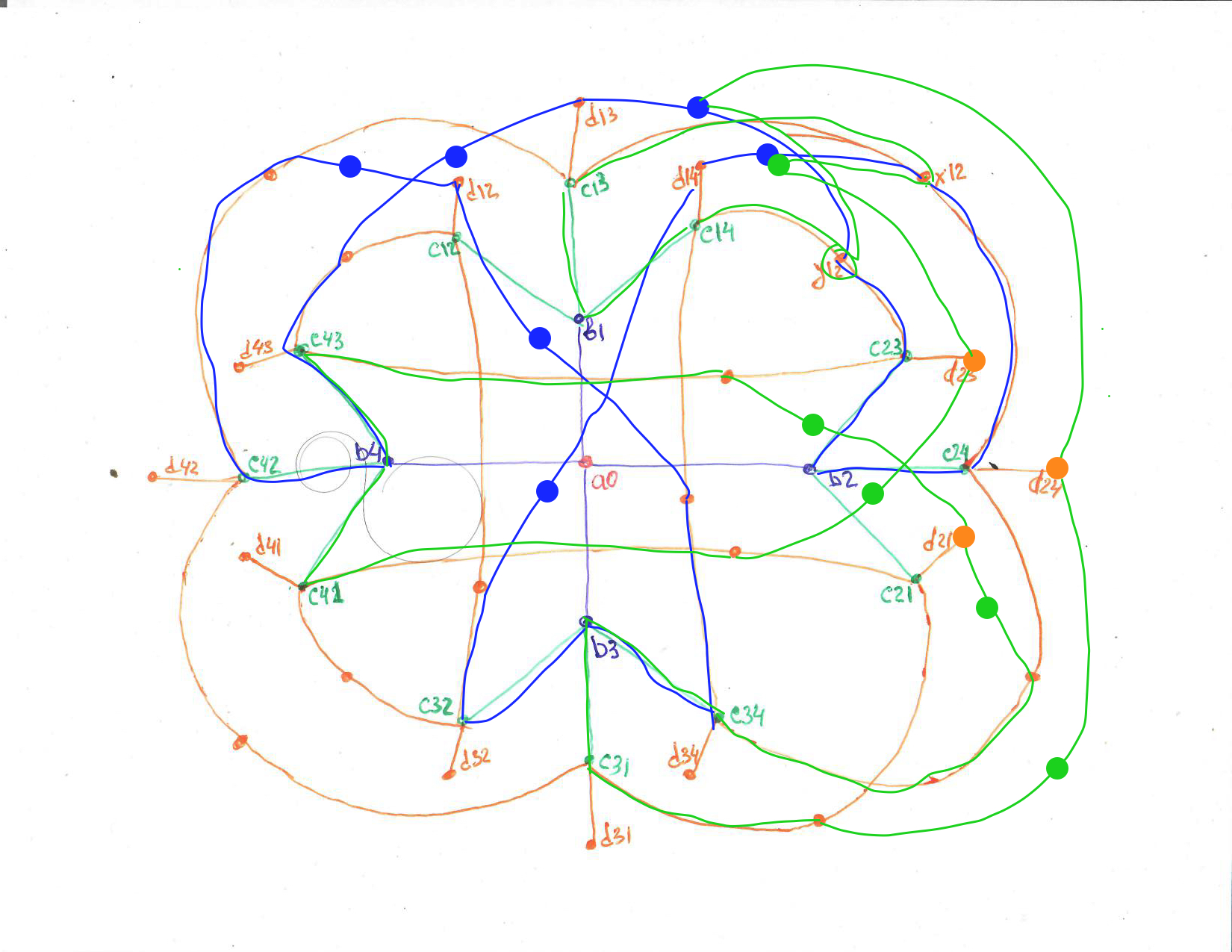
Starting from the source diagram b1-1. BaseConfig_1stType.jpg,
construct 12-dicycles around the root's four 1-nodes
b1, b2, b3, and b4.
The first research line is to reuse existing nodes whenever possible while
preserving C1-C4, and to prefer completions where each parallel pair of
di-links shared by two dicycles has one X-type middle point and one Y-type
middle point.
Scope
| Included Now | Deferred |
|---|---|
Root-local completion around b1..b4; construction of
similar 12-dicycles for all four root 1-nodes; explicit
accounting of new versus reused 3-nodes.
|
Full all-node infinite construction; proof of aperiodicity; C5 proof or finite-radius C5 evidence past level 10. |
The first line of research: for every existing pair of dicycles around
b1..b4, test completions where middle points on the two
parallel di-links are of different types: one X-node and one Y-node.
|
Relaxations that change the loop budget, such as 6-loop plus 8-loop models, unless a later PRD-04 amendment explicitly adds them. |
A level-by-level growth plan: after root 1-nodes, apply
the same construction discipline to 2-nodes and onward.
|
Treating a local root sketch as proof that all later shells can be completed. Every shell must carry its own C1-C4 evidence. |
Terms Borrowed From PRD-03
PRD-04 reuses the PRD-03 graph vocabulary, with only the narrower construction target changed.
| Term | Meaning in PRD-04 |
|---|---|
node |
A graph vertex. Every completed non-frontier node must have degree 4. |
n-node |
A node at graph distance exactly n from the chosen center. Around the root, b1..b4 are the 1-nodes. |
bundle |
The group of three 2-nodes hanging off a given 1-node. |
di-link |
A two-edge chain 2-node -> 3-node -> 2-node joining two 2-nodes of different bundles. |
dicycle |
A cycle alternating 2-nodes and 3-nodes. A 12-dicycle has 12 di-links and 24 graph edges. |
X-node |
For a pair of dicycles, a reused middle 3-node where the two dicycles use different incident edge-pairs of the node, so all four incident edges are used across the pair. |
Y-node |
For a pair of dicycles, a reused middle 3-node where the two dicycles share one adjacent incident edge at that node. |
Hard Constraints
| ID | Constraint | PRD-04 interpretation |
|---|---|---|
| C1 | 4-regularity | Every completed node has exactly four incident edges. Frontier incompleteness must be explicit and counted, not hidden. |
| C2 | No small loops | No cycle of length 5 or less. In particular, same-bundle di-links are forbidden because they would form 4-loops. |
| C3 | 12-hexagon rule | For each node, each of the six edge-pairs must lie in exactly two 6-loops. PRD-04 must track this locally whenever a new dicycle is completed. |
| C4 | Di-link / dicycle structure | Every valid di-link belongs to a dicycle, and PRD-04's first target is a 12-dicycle around each root 1-node. |
| C5 | Quadratic graph-distance growth | Tracked as future evidence only. Do not accept or reject PRD-04 Task 04-01 on C5 before level-over-10 completions exist. |
Source Figures
Figures are embedded here as clickable images. Click any figure to open the original source file.
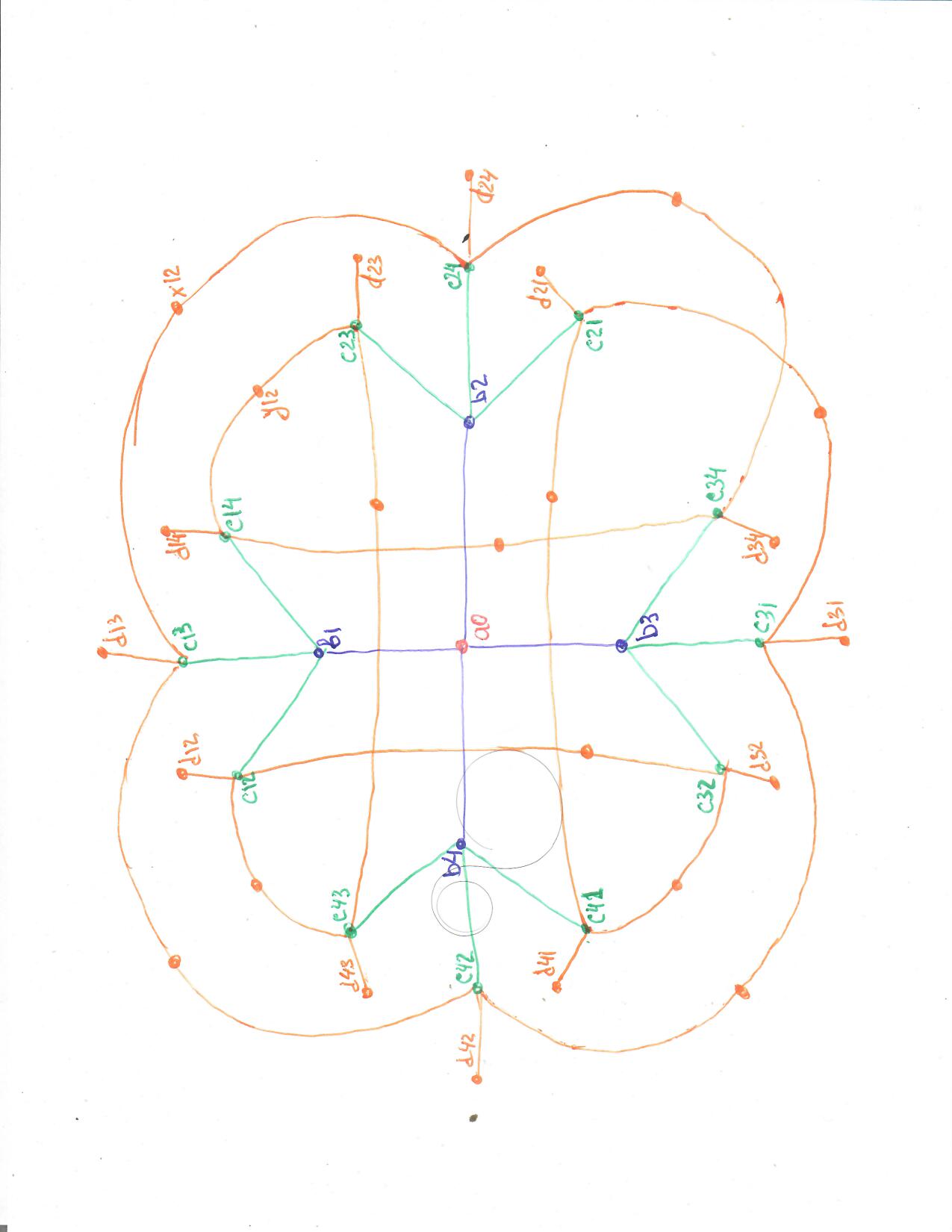
b1-1. BaseConfig_1stType.jpg. PRD-04
begins here, using the root 1-nodes b1..b4
as the first completion targets.
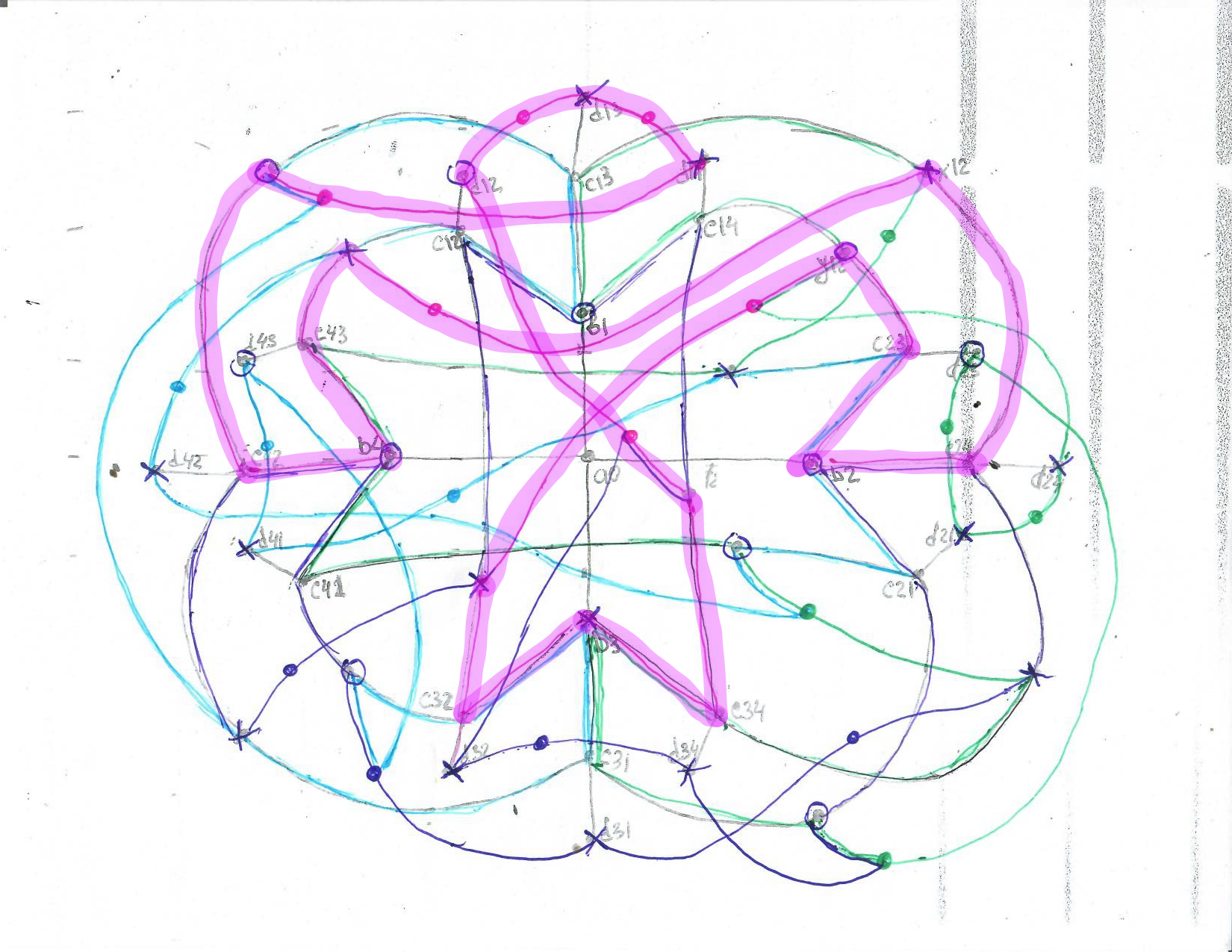
b1. This is the
first pattern to imitate for the other root 1-nodes.
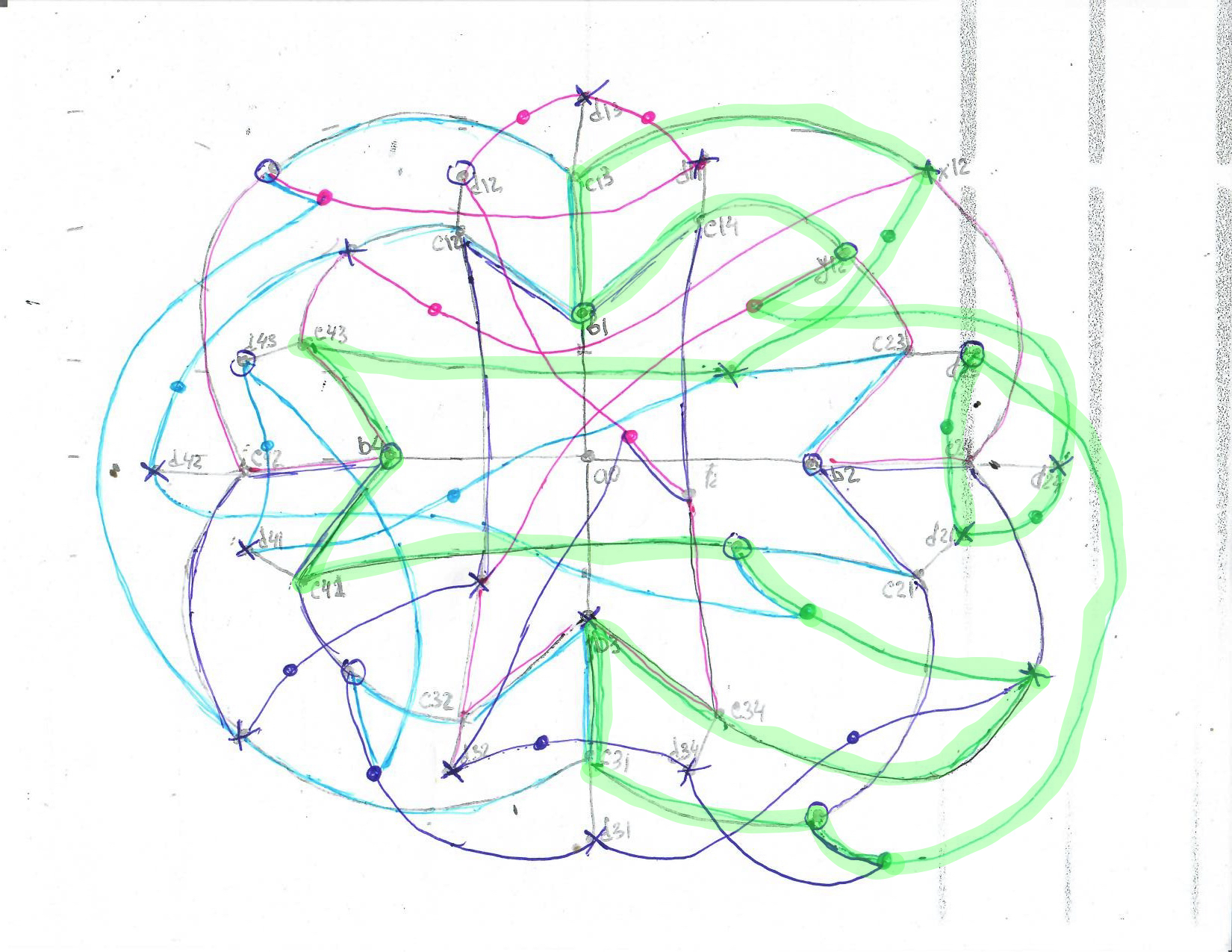
b2. PRD-04 asks
for analogous completions around b1, b2,
b3, and b4.
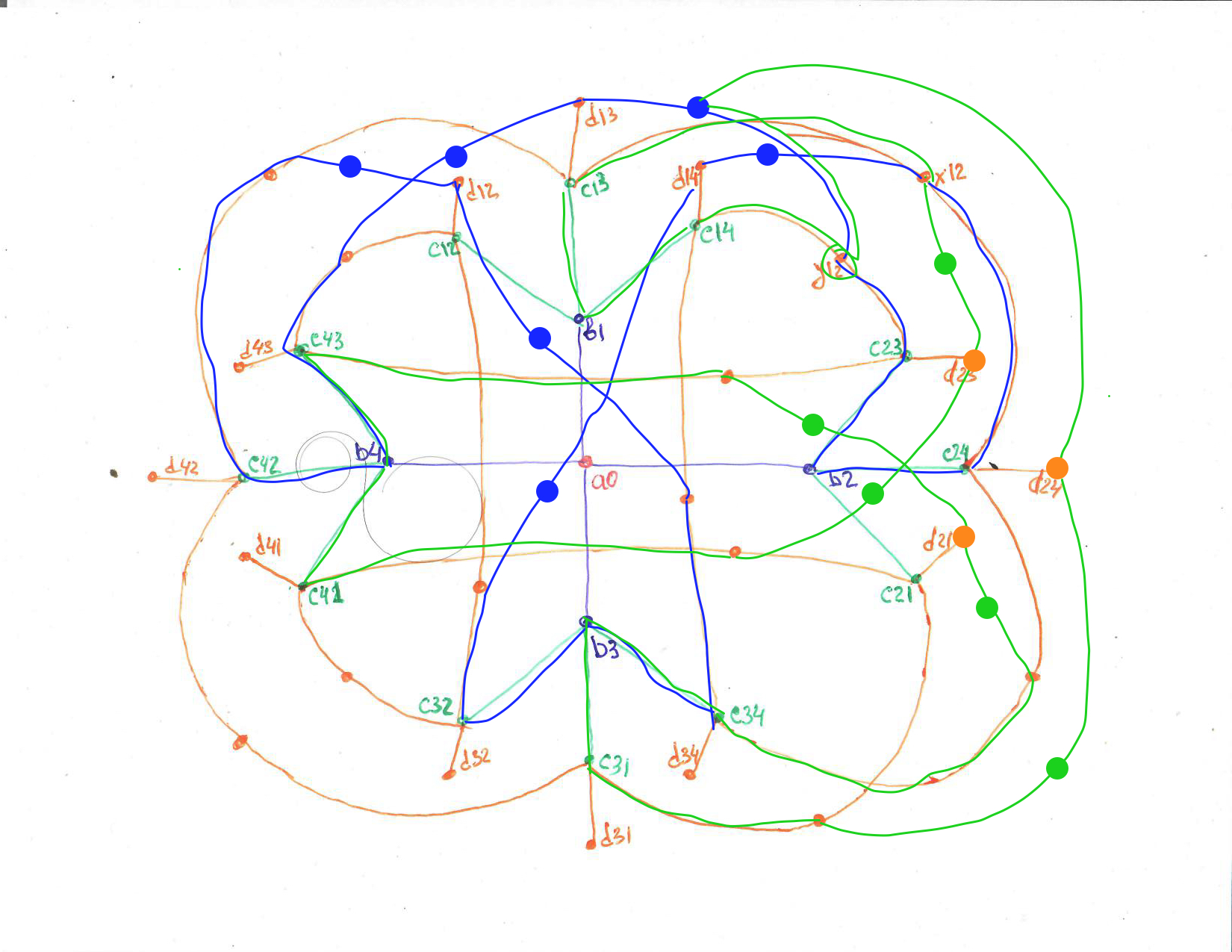
x12, so all four incident edges are used
across the pair.
x12.
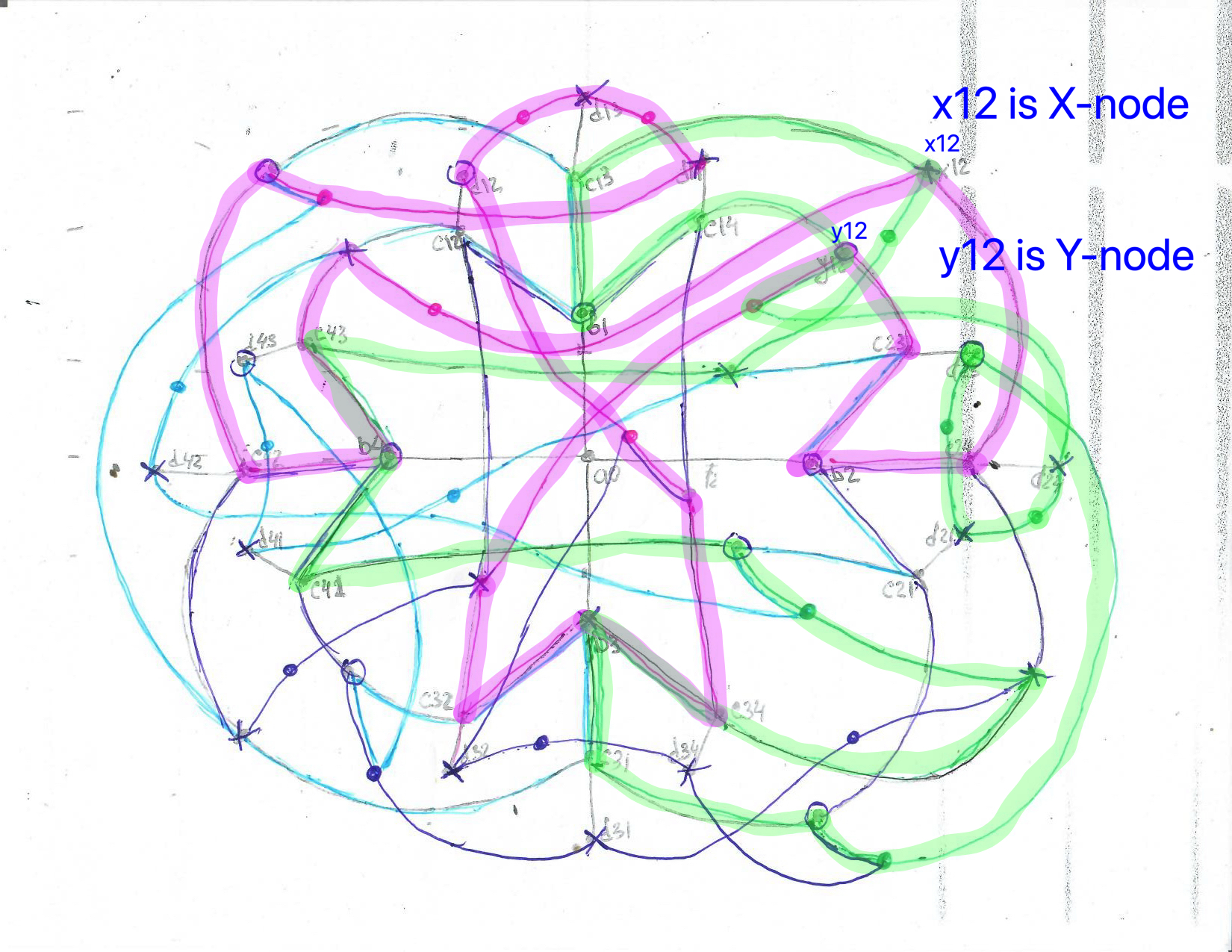
b1 and green dicycle
around b2 create an X-node at x12 and a
Y-node at y12, the desired mixed-type pattern for
parallel di-links.
X/Y Reuse Model
For a pair of dicycles, the target first search family is not merely "reuse nodes" or "create new nodes." It is specifically: when two parallel di-links occur between the same pair of bundles, use different middle-point types across the pair, one X and one Y.
Construction Rules
-
Start from
b1-1and preserve all existing edges and node identities unless a candidate completion proves that reuse violates C1-C4. -
Construct or validate the known pink 12-dicycle around
b1first, then construct analogous 12-dicycles aroundb2,b3, andb4. -
For each pair among
{b1,b2,b3,b4}, inspect the two parallel di-links between the same bundle pair. The preferred completion has one X-node and one Y-node across that parallel pair. -
When adding a dicycle, explicitly classify every intermediate
3-node as existing reused, existing unused, or newly created. - Reject a candidate immediately if it creates a degree greater than 4, a same-bundle di-link, a loop of length 5 or less, or an unaccounted C3 edge-pair count.
-
After all four root
1-node dicycles are complete, repeat the same process for eligible2-nodes, then for later shells.
Task 04-01: Root 1-Node 12-Dicycle Completion
first task research + construction C1-C4 only
Objective
Produce a finite root-level completion candidate from b1-1 in
which each root 1-node b1..b4 has a 12-dicycle,
and every pair of dicycles among those four follows the mixed X/Y target
on parallel di-links when possible.
Required Inputs
assets/b1-1-base-config-1st-type.jpgassets/b1-1-pink-12-dicycle.jpgassets/b1-1-green.jpgassets/b1-1-pink-green-12-dicycles.jpgassets/prd-03-aperiodic-web-lattice.mdfor the source PRD-03 definitions of C1-C4, di-link, dicycle, bundle, X-node, and Y-node.
Acceptance Criteria
| ID | Criterion | Evidence required |
|---|---|---|
| AC1 | Candidate contains 12-dicycles around all four root 1-nodes. |
Machine-readable graph plus human-readable cycle listing for b1, b2, b3, and b4. |
| AC2 | Each candidate node and edge has a provenance tag. | Table with existing, reused, new, and frontier/unfilled counts. |
| AC3 | Every pair among the four root dicycles is checked for mixed X/Y parallel middle points. | Six pair reports: b1-b2, b1-b3, b1-b4, b2-b3, b2-b4, b3-b4. |
| AC4 | C1-C4 hold for all completed non-frontier nodes in the root-local candidate. | Verifier output with exact pass/fail counts. If C3 is only partially checkable, report the exact unchecked surface. |
| AC5 | Failure is useful if no candidate exists. | Minimal blocker report naming the first violated constraint, the involved nodes/di-links, and whether the blocker comes from X/Y reuse, degree saturation, small loops, or C3 counts. |
Future Task Ladder
| Task | Target | Entry condition |
|---|---|---|
| 04-01 | Complete root 1-node dicycles around b1..b4. |
Starts from this PRD. |
| 04-02 | Apply the same mixed X/Y reuse discipline to selected 2-nodes. |
Requires a Task 04-01 candidate or blocker report. |
| 04-03 | Grow shell-by-shell while keeping exact C1-C4 evidence at each shell. | Requires at least one repeatable 2-node completion strategy. |
| 04-04 | Run C5 evidence checks once completed levels exceed 10. | Requires a finite graph with completed shells beyond level 10. |
Relationship To PRD-03
PRD-04 borrows basic terminology, C1-C5, and the source diagram vocabulary from PRD-03, but it is intentionally narrower. PRD-03 remains the broader aperiodic-web research line and record of prior Z4, coordinate-free, export, and dense-construction work. PRD-04 starts a focused line around one concrete completion discipline: root 12-dicycles with mixed X/Y reuse.